Transformation Part 2 - Driving Change
Leadership is the engine of sustainable transformation, from mandate to movement.
Change Log
- Updated to version 1.1.0
- Added four mermaid diagrams illustrating Schein's three-layer culture model (Figure 5), Push vs. Pull dynamics (Figure 6), Rogers' Diffusion curve with Moore's Chasm (Figure 7), and Conway's Law with the Inverse Conway Maneuver (Figure 8).
- Figure numbering continues the series convention (Part 1 has 1 to 4, Part 2 has 5 to 8, Part 3 has 9 to 11).
- Previous version 1.0.0 wrote the full content replacing the "Coming soon!" placeholder; added Pull Engineering framework, cultural immune system, Conway's Law sections, Diffusion of Innovations model, movement-building architecture, and literature citations.

TL;DR
- Mandates create resistance. Announcing change from above is the least effective way to make it stick, because it activates the organization’s cultural immune system.
- Create pull, not push. Build conditions in which people want to change instead of compelling them.
- Map your audience with the Diffusion Curve. Innovators and Early Adopters are your beachhead; reach the Early Majority through them, not around them.
- Respect Conway’s Law. Your communication structure determines the architecture of every system you build, so redesign how people talk before redesigning what they build.
- Prototype instead of presenting. Introduce change as experiments that invite participation, not as finished solutions that demand compliance.
- Digitalization accelerates culture, good and bad. Fix the human side first, then use technology as a force multiplier.
The Journey: Where Do You Need to Go?
From Diagnosis to Action
Part 1 established the diagnostic foundation: by locating your organization on the S-curve, tracking Time-to-Productivity (TTP) and Duration-of-Employment (DoE), and monitoring the Cultural Drag Index (CDI), you now have a clear picture of where you stand. But diagnosis alone changes nothing. The question becomes: how do you move?
This article covers the leadership side of that movement. It relies on creating the conditions for sustainable change, not on mandates and reorganization charts. The thesis is simple: transformation that lasts is pulled from within, not pushed from above.
To know where you need to go, answer three questions honestly:
- What does the desired state look like in measurable terms: lower CDI, shorter TTP, higher DoE?
- Which of your people are already living in that desired future, and how do you amplify their influence?
- What structural and systemic changes are needed to stop the organization from defaulting back to its current patterns?
Why Top-Down Mandates Fail
The most common response to a deteriorating CDI or declining business performance is a top-down transformation programme: a new operating model announced from the C-suite, a reorganization, a technology rollout, or a culture initiative backed by external consultants. These efforts consume enormous resources, and most fail.
The research is consistent. Beer, Eisenstat, and Spector’s Harvard Business Review study, Why Change Programs Don’t Produce Change (1990), found that formal change programs built around training, culture workshops, or restructuring consistently underperform because they treat symptoms instead of root causes. The root cause is nearly always the same: the day-to-day work context (the roles, relationships, and responsibilities that organize behaviour) stays unchanged. New values posted on walls change nothing if the incentive structures, reporting lines, and decision-making processes remain identical.
John Kotter’s eight-step model for leading change (1996) supports this. The first four steps (establishing urgency, forming a coalition, building a vision, and communicating it) are consistently underinvested. Organizations rush to the “how” (structure, process, technology) and skip the “why” (shared purpose, real urgency, a trusted leadership coalition). The result is a technically competent rollout that the workforce sees as yet another management initiative to be waited out.
The deeper reason mandates fail is what I call the cultural immune system.
The Cultural Immune System
Every organization has developed, over time, a set of deeply embedded assumptions, habits, and informal rules that define “how things are done here.” Edgar Schein’s model of organizational culture (2010) distinguishes three layers:
- Artifacts: visible structures, processes, office design, communication tools. This is what you can observe.
- Espoused values: the stated strategies, goals, and philosophies. This is what leadership says matters.
- Basic assumptions: the unconscious, taken-for-granted beliefs that drive behaviour. This is what people do, whatever is said.
Figure 5 shows the three layers and why the deepest one resists change so strongly.
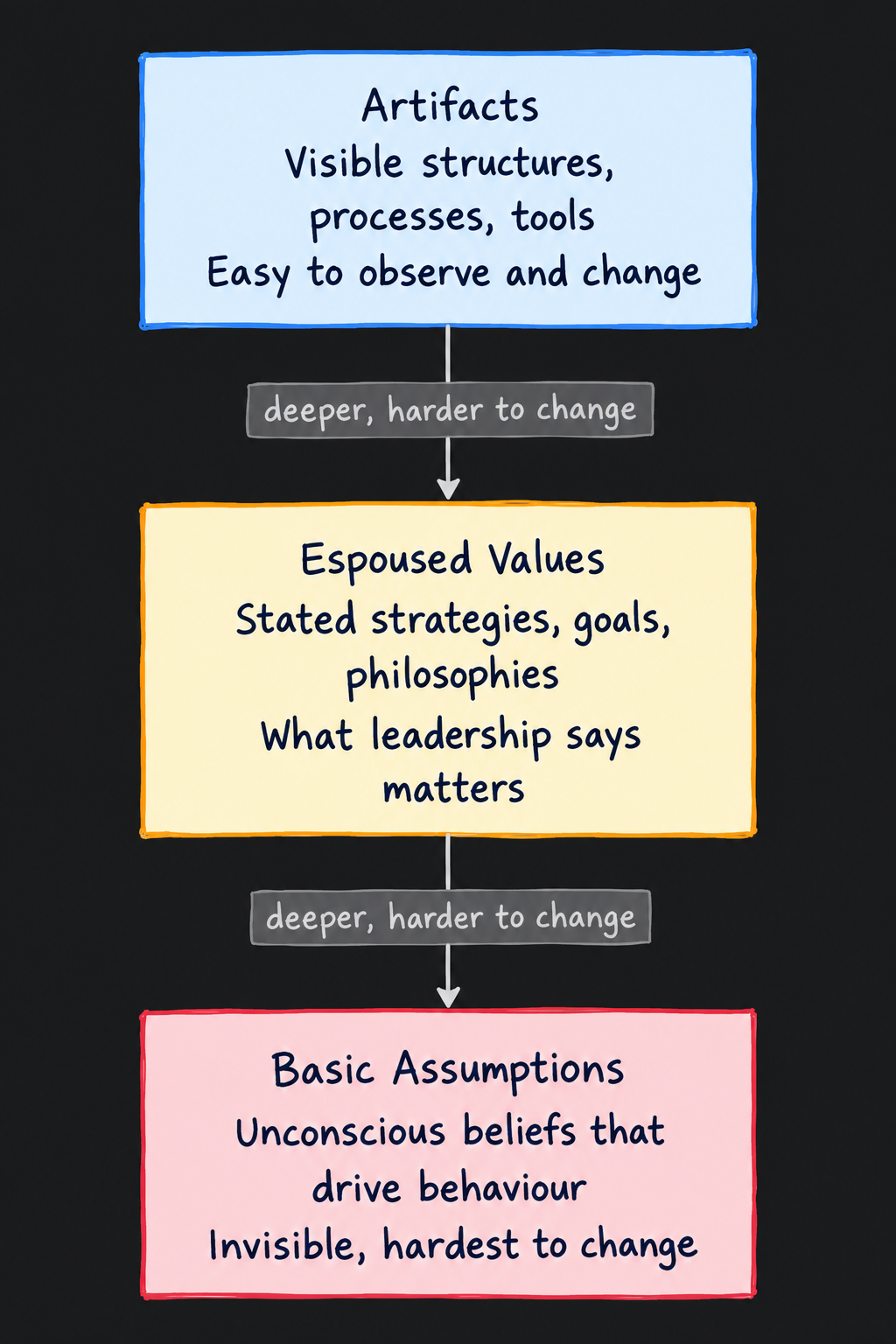 Figure 5: Schein’s three-layer model of organizational culture. Transformations that touch only the top layer rarely stick. The deeper the layer, the harder it is to change.
Transformation often succeeds at the artifact level (new tools, new org charts, new processes) and leaves basic assumptions untouched. When an initiative threatens those assumptions, the organization activates its cultural immune system. That is self-preservation, not malice. The immune system shows up as:
- Reframing: “We tried this in 2018. It didn’t work then either.”
- Waiting: “Let’s see if leadership is serious this time.”
- Procedural drag: “We need to go through the governance committee before we can start.”
- Selective compliance: doing just enough to satisfy the reporting requirement while preserving the old way of working underneath.
The immune system is not the enemy. It exists because the organization has learned, often through painful experience, to protect what works. The challenge is to work with it. Introduce change in ways that do not trigger an immune response: gradually, credibly, and anchored in real problems the organization already recognizes as urgent.
Pull Engineering: Creating Conditions for Change
Pull Engineering is the practice of designing the organizational environment so that the desired change becomes the path of least resistance, the thing people want to do instead of the thing they are told to do.
Figure 6 contrasts the two dynamics: the usual failure mode of a top-down mandate and the self-reinforcing pattern of a movement built through pull.
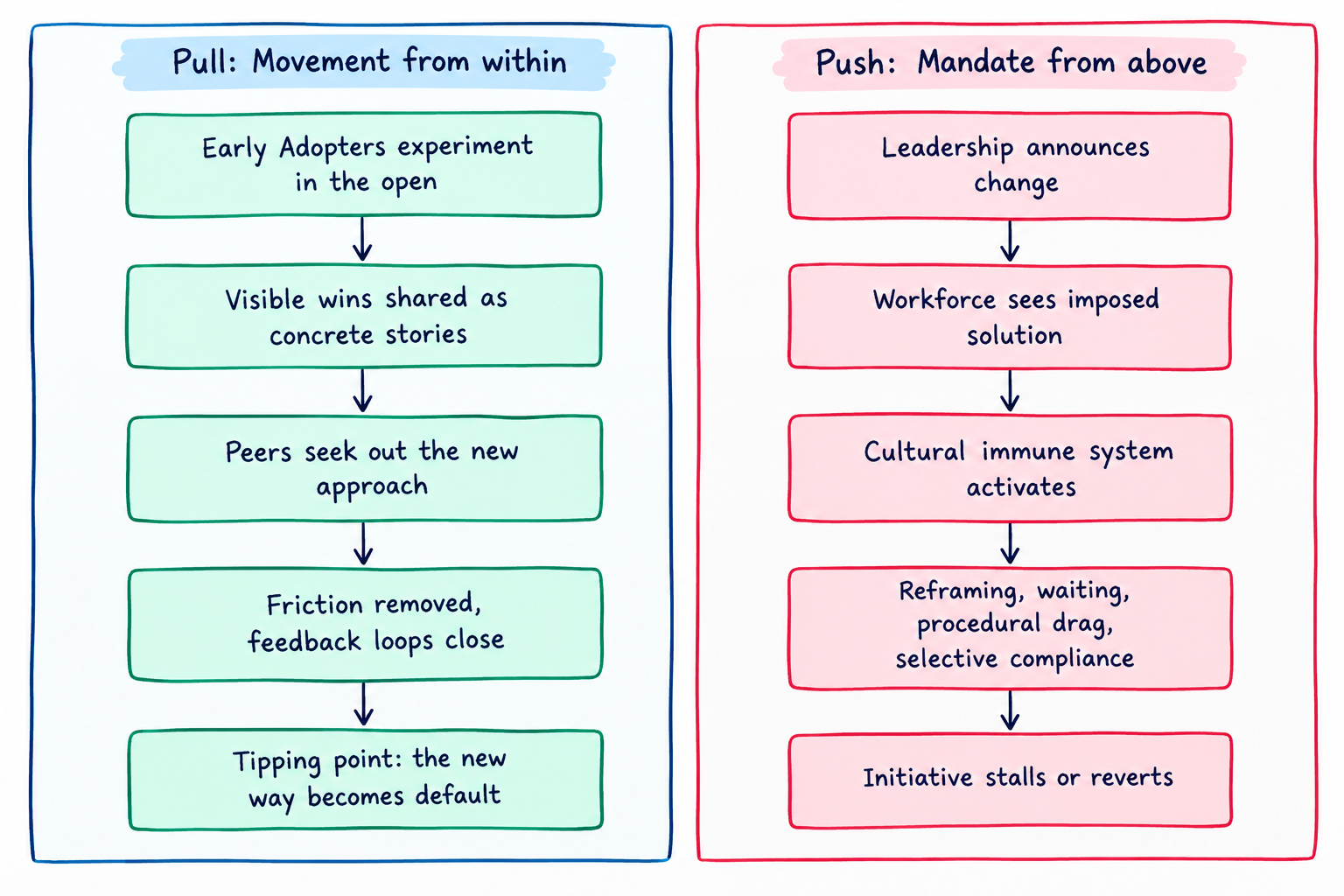 Figure 6: Push vs. Pull. Mandates trigger the cultural immune system and tend to revert; pull engineering compounds small wins into a self-sustaining movement.
The concept draws on Peter Senge’s systems thinking in The Fifth Discipline (1990): lasting change in complex systems comes from shifting underlying structures (incentives, information flows, decision rights), not from pushing harder on the existing one. Daniel Pink’s research on motivation (Drive, 2009) adds that people are intrinsically motivated by autonomy (control over their work), mastery (the chance to improve at something that matters), and purpose (a connection to a meaningful goal). Mandates undermine all three. Pull Engineering activates them.
Pull Engineering has four levers.
-
Make the problem visceral. Change begins when the gap between current reality and the desired future becomes impossible to ignore. Data helps (CDI trends, TTP baselines, DoE trajectories), but data alone rarely moves people. Stories do. Find cases where the current way of working concretely failed someone and tell those stories, with permission and specifics. Urgency has to be felt, not just understood (Kotter, 1996).
-
Remove friction from the new behaviour. If the new way takes more effort than the old one, most people fall back on the old one whatever their intentions. Richard Thaler and Cass Sunstein’s research on behavioural design (Nudge, 2008) shows that defaults are extremely powerful. Design the environment so that doing the right thing is also the easy thing.
-
Create social proof. People learn from each other. When they see respected colleagues adopt a new approach and succeed, adoption speeds up. That is why early champions matter more than senior sponsors: people follow peers, not just authority.
-
Build feedback loops. People sustain new behaviours when they see the results of their actions. Make the impact of the change visible and frequent, and tie it to metrics the team already cares about (TTP, quality, speed) instead of abstract transformation KPIs.
Identifying and Empowering Champions
Everett Rogers’ Diffusion of Innovations (1962; 5th ed. 2003) is the best-supported model of how new ideas spread through populations. Rogers identified five adopter categories:
Table 1: Adopter Categories and Their Characteristics
| Adopter Category | Share of Population | Characteristics |
|---|---|---|
| Innovators | ~2.5% | Venturesome, risk-tolerant, connected to external knowledge networks |
| Early Adopters | ~13.5% | Respected opinion leaders within the system; judicious and deliberate |
| Early Majority | ~34% | Deliberate; adopt just before the average member; need proven solutions |
| Late Majority | ~34% | Skeptical; adopt under peer pressure or economic necessity |
| Laggards | ~16% | Tradition-bound; final holdouts; often the most vocal critics |
For transformation leaders, the key point is that the Early Majority does not follow Innovators. It follows Early Adopters. Geoffrey Moore extended Rogers’ model in Crossing the Chasm (1991) by identifying the gap between Early Adopters, who embrace new ideas on vision alone, and the Early Majority, who demand proven, complete solutions. Most transformation initiatives stall in this “chasm.”
Figure 7 shows the five adopter categories and the location of Moore’s chasm. Programmes stall there because they assume continuous diffusion when there is actually a discontinuity.
flowchart LR
    I["Innovators<br/>~2.5%<br/>Venturesome,<br/>risk-tolerant"]
    EA["Early Adopters<br/>~13.5%<br/>Trusted opinion<br/>leaders"]
    CHASM["THE CHASM<br/>(Moore, 1991)<br/>vision-to-proof gap"]
    EM["Early Majority<br/>~34%<br/>Deliberate<br/>pragmatists"]
    LM["Late Majority<br/>~34%<br/>Skeptical;<br/>peer pressure"]
    L["Laggards<br/>~16%<br/>Tradition-bound<br/>holdouts"]
    I --> EA --> CHASM --> EM --> LM --> L

    classDef adopter fill:#dbeafe,stroke:#2563eb,color:#0f172a
    classDef chasm fill:#fef3c7,stroke:#d97706,color:#0f172a,stroke-width:3px
    class I,EA,EM,LM,L adopter
    class CHASM chasm
Figure 7: Rogers’ Diffusion of Innovations curve with Moore’s Chasm. Early Adopters buy vision; the Early Majority demands proof. Most transformation efforts fail to bridge the gap.
So identify your Early Adopters first. They are not necessarily the most senior or the most vocal people. They are the people whose professional judgment the pragmatic majority trusts. Look for these signals:
- They have already informally solved the problem you are trying to address.
- They are connected across organizational boundaries, not siloed in one function.
- They are sought for advice by peers who would not ask the same question of a manager.
- They have a track record of implementing ideas, not just proposing them.
Once you have identified them, invest in these champions disproportionately. Give them resources, visibility, and explicit air cover to experiment. Protect them from the immune system’s instinct to suppress deviation. Connect them to each other, so that a distributed network of change, not a single point of failure, drives the movement.
Conway’s Law: Structure as Strategy
In 1968, computer scientist Melvin Conway observed: “Organizations which design systems are constrained to produce designs which are copies of the communication structures of these organizations” (Conway, 1968). This observation, now known as Conway’s Law, has been confirmed repeatedly in software engineering, product development, and organizational design.
The implication for transformation is often overlooked: you cannot redesign your products, services, or processes without first redesigning the communication structures that produce them. A siloed organization will produce siloed systems. A hierarchical approval chain will produce a slow, hierarchical product. A cross-functional, collaborative team will produce integrated solutions.
Software architects call the reverse the Inverse Conway Maneuver: instead of letting organizational structure dictate system architecture, design the organizational structure to produce the architecture you want. Figure 8 contrasts the two directions.
flowchart TB
    subgraph A["Default: Conway's Law"]
        direction LR
        OC1["Organizational<br/>communication structure"] -->|"shapes"| SC1["System or product<br/>architecture"]
    end
    subgraph B["Deliberate: Inverse Conway Maneuver"]
        direction LR
        SC2["Desired system<br/>architecture"] --> OC2["Re-design<br/>communication<br/>structure"]
        OC2 --> RES["Architecture<br/>you actually want"]
    end
    A ~~~ B

    classDef original fill:#fef3c7,stroke:#d97706,color:#0f172a
    classDef inverse fill:#d1fae5,stroke:#059669,color:#0f172a
    class OC1,SC1 original
    class SC2,OC2,RES inverse
Figure 8: Conway’s Law in its default direction (top) and reversed as the Inverse Conway Maneuver (bottom). Restructuring communication patterns comes before the architecture you intend to build, not after.
For transformation leaders, this means:
- Before launching a new initiative, ask: does our current communication structure enable or constrain what we are trying to build?
- If the answer is constrain, restructure first. That does not have to mean the org chart; change the actual patterns of communication, decision-making, and accountability.
- Create cross-functional teams around customer outcomes rather than functional specializations.
- Reduce the number of approval layers between a frontline insight and a meaningful decision.
Conway’s Law also explains why technology deployments often fail when they cross organizational boundaries without matching structural change. The technology reflects the communication structure. If that structure is fragmented, the technology produces fragmented outcomes however capable it is.
Prototyping Change
Most change programmes arrive with a fully developed solution: a new operating model, a new system, a new set of processes, polished, presented, and ready for rollout. That is understandable but counterproductive. It casts the workforce as passive recipients of a decision already made, and that triggers resistance.
The alternative is prototyping: introduce change as an experiment, openly incomplete and open to modification. The psychological effect is large. A prototype invites participation. It says: “We have an idea. We are not certain it is right. Help us find out.” A finished solution says: “This is how things will be done. Train yourself to comply.”
Prototyping in organizational transformation draws on IDEO’s design thinking methodology (Brown, 2009) and Eric Ries’ Lean Startup approach (2011):
- Define the smallest version of the change that can be tested. What is the minimum viable change (MVC) that would demonstrate the core hypothesis?
- Run it with willing participants first, your Early Adopters. It is a real experiment with an honest question, not a scaled-down rollout.
- Make the learning visible. Share what worked, what did not, and what you learned. This builds credibility, not for having the right answer but for being honest about the process.
- Iterate before scaling. The prototype is the first step in a learning loop, not the final answer. Refine it with what you learn before broadening scope.
Prototyping also changes the politics of transformation. When the organization sees that nothing is irreversible and that its input shapes the outcome, the immune system’s defensive posture softens, and resistance turns into co-creation.
Digitalization as Catalyst, Not Cure
Part 1 drew the line between transformation and digitalization, and it matters for leadership practice too. Organizations under pressure to transform are tempted to reach for technology first. The logic is intuitive: technology is visible, its costs and timelines can be estimated, and deploying it looks like action. Culture change is invisible, slow, and hard to measure.
Technology deployed into an unhealthy culture does not fix that culture. It amplifies it. A digitalized bureaucracy is still a bureaucracy, only faster. A digitalized silo is still a silo, only better defended. As noted in Part 1, digitalization can speed up how fast organizational dysfunction propagates.
The order that works:
- Diagnose the cultural state (Part 1: CDI, TTP, DoE).
- Build the human infrastructure (Part 2: champions, pull, structure).
- Introduce technology as an accelerant of the cultural patterns you are already establishing.
You don’t have to wait for a perfect culture before investing in technology. The human dimension has to lead, and technology should reinforce the cultural outcomes you want, not substitute for them. A collaboration platform deployed into a trust-deficit organization will be used primarily for surveillance. The same platform deployed into a psychologically safe environment becomes a genuine knowledge-sharing engine (Edmondson, 2018).
Building a Movement
Individual champions and isolated prototypes are necessary but not enough. Transformation reaches critical mass when it becomes a movement: a self-sustaining pattern of behaviour that no longer needs a central push.
Malcolm Gladwell’s The Tipping Point (2000) describes the threshold at which ideas shift from minority to majority behaviour. In organizational transformation, that point lies somewhere in the Early Majority: when, as a rule of thumb, roughly 15-20% of the workforce have genuinely adopted the new way of working and are demonstrably better off for it, the organizational narrative shifts. The question stops being “why should we change?” and starts being “why haven’t we changed yet?”
To reach that tipping point you need:
- Consistent, transparent communication. Skip the monthly all-hands update and keep up a steady stream of small stories: what was tried, what was learned, who was involved, what changed. Kotter (1996) calls this “communicating the vision.” It is closer to building a shared narrative about a better future that is already partly visible.
- Celebrating learning, not just success. If only successes are celebrated, people learn to hide failures. If failures are treated as data (“we tried this, learned X, and adjusted”), the organization learns together. Amy Edmondson’s research on psychological safety (2018) shows that high-performing teams in uncertain environments treat mistakes as information, not indictments.
- Removing systemic blockers. As the movement grows, it will hit structural obstacles: legacy approval processes, incompatible incentives, reporting lines that reward old behaviours. Senior leaders should not champion the change programme. Their job is to remove these blockers and use their positional authority to protect the movement from the immune system.
- Connecting champions into a network. Isolated champions burn out. Champions connected to each other reinforce, learn from, and sustain each other. Create formal and informal spaces for this network to function: cross-functional working groups, internal communities of practice, regular peer-learning sessions.
Conclusion: The Journey Is the Work
It is tempting to treat the journey as an unfortunate necessity, a turbulent bridge between the current state and the destination. But the journey is the work. The relationships between champions, the experiments you run and learn from, and the structural changes that enable new communication patterns are not preconditions to transformation. They are the transformation.
Part 1 gave you the diagnostic tools: S-curve positioning, TTP, DoE, CDI, and the business and culture health model. Part 2 gave you the leadership framework: Pull Engineering, the cultural immune system, the Diffusion of Innovations model, Conway’s Law, prototyping, and the conditions for building a movement. Together they make up an evidence-based, human-centred practice of organizational change.
Part 3 addresses the question that turns a transformation journey into a strategic capability: not just how to change, but why you are on this path, and whether the business you are transforming is still headed in the right direction.
Outlook: Part 3, Controlled Self-Disruption
Even a transformation that improves culture health and leadership capability faces a strategic question: is the business model at the centre of all this effort still viable? Part 3 covers controlled self-disruption: questioning and, where necessary, cannibalizing your own business before a competitor or a market shift does it for you. It introduces the ambidextrous organization, the Three Horizons portfolio framework, and a business viability matrix that connects the cultural diagnostics of Part 1 to the strategic decisions organizations eventually have to make.
References
- Beer, M., Eisenstat, R. A., & Spector, B. (1990). Why change programs don’t produce change. Harvard Business Review, 68(6), 158-166.
- Brown, T. (2009). Change by Design: How Design Thinking Transforms Organizations and Inspires Innovation. HarperBusiness.
- Conway, M. E. (1968). How do committees invent? Datamation, 14(4), 28-31.
- Edmondson, A. C. (2018). The Fearless Organization: Creating Psychological Safety in the Workplace for Learning, Innovation, and Growth. Wiley.
- Gladwell, M. (2000). The Tipping Point: How Little Things Can Make a Big Difference. Little, Brown.
- Kotter, J. P. (1996). Leading Change. Harvard Business Review Press.
- Moore, G. A. (1991). Crossing the Chasm: Marketing and Selling High-Tech Products to Mainstream Customers. HarperBusiness.
- Pink, D. H. (2009). Drive: The Surprising Truth About What Motivates Us. Riverhead Books.
- Ries, E. (2011). The Lean Startup: How Today’s Entrepreneurs Use Continuous Innovation to Create Radically Successful Businesses. Crown Business.
- Rogers, E. M. (2003). Diffusion of Innovations (5th ed.). Free Press. (Original work published 1962)
- Schein, E. H. (2010). Organizational Culture and Leadership (4th ed.). Jossey-Bass.
- Senge, P. M. (1990). The Fifth Discipline: The Art and Practice of the Learning Organization. Doubleday.
- Thaler, R. H., & Sunstein, C. R. (2008). Nudge: Improving Decisions About Health, Wealth, and Happiness. Yale University Press.