Transformation Part 3 - Controlled Self-Disruption
Strategic reflection and self-disruption as the real test of transformation leadership.
Change Log
- Updated to version 1.0.2
- Renumbered figures (5 to 9, 6 to 10, 7 to 11) to make room for Part 2's four new mermaid diagrams and keep the series-wide figure numbering sequential.
- Previous version 1.0.1 extended the series bibliography with the new works cited in Part 1 v1.2.0 (Adizes, Allen, Bauer, Cameron & Quinn, Foster, Kotter & Heskett, Lewin, Rollag/Parise/Cross, Westerman/Bonnet/McAfee).
- Earlier version 1.0.0 wrote the full content replacing the "Coming soon" placeholder; added Innovator's Dilemma analysis, ambidextrous organization framework, Three Horizons model, business viability matrix, pivot decision framework, antifragility lens, and the initial series bibliography.

TL;DR
- Reflect on strategy regularly. Ask not only “how healthy is our culture?” but “are we transforming the right business?”
- The Innovator’s Dilemma is structural. Incumbents are biased against the disruptions that will eventually replace them, and understanding that bias is the first step to overcoming it.
- Controlled self-disruption is proactive: question and cannibalize your own business model before the market forces you to.
- Build an ambidextrous organization that exploits the current business (Horizon 1) and explores new models (Horizons 2 and 3) without letting one destroy the other.
- Business viability and cultural health depend on each other. Connect the CDI, TTP, and DoE diagnostics from Part 1 to the model viability analysis introduced here.
- Know when to pivot. If business model health is declining and cultural health cannot recover it, incremental improvement only delays the outcome.
The Reflection: Why Are You on This Path?
From Action to Meaning
Part 1 gave you the cultural diagnostic: S-curve positioning, TTP, DoE, and the Cultural Drag Index. Part 2 gave you the leadership engine: Pull Engineering, champions, Conway’s Law, and the movement-building architecture. Neither Part 1 nor Part 2 can answer one question: is the business at the centre of this transformation still pointed in the right direction?
This is the hardest question in organizational strategy. Leaders have to tell apart two different problems:
- An execution problem: the right strategy, poorly implemented. The tools in Parts 1 and 2 address it.
- A strategy problem: the wrong strategy, well implemented. Only a willingness to question the direction itself addresses it.
Most transformation programmes assume the first. Cultural drag is too high, change management was poor, leadership was misaligned; fix those and the business will perform. That is often right, but sometimes it is badly wrong. An organization may be transforming a business model that will not survive the next decade however smoothly the transformation runs.
So this final part asks the uncomfortable question: are you transforming the right thing?
The Innovator’s Dilemma: Why Good Companies Fail
Clayton M. Christensen’s The Innovator’s Dilemma (1997) is one of the best-supported and most counterintuitive ideas in business strategy. Well-managed, well-resourced, customer-focused companies lose to disruptive innovations, not because they are incompetent but because they are too good at serving their existing customers with their existing business models.
The mechanism works like this:
- Established companies invest in sustaining innovations: improvements to existing products and services along the dimensions current customers value most.
- Disruptive innovations initially perform worse on those dimensions but offer other attributes, such as lower cost, easier access, or simpler operation, that appeal to non-consumers and to low-end segments incumbents ignore.
- As the disruptive technology improves, it starts to satisfy the incumbent’s mainstream customers. By then the incumbent cannot compete, because its cost structure, processes, and values are all optimized for the old game.
For transformation leaders, this means your CDI, TTP, and DoE measurements, and all your cultural health work, may be optimizing a business model that is already under disruptive attack from below. Christensen’s research suggests the organizations that survive disruption are not the ones that transform their existing business faster. They are the ones that create a separate organizational unit to pursue the disruptive opportunity, insulated from the core business’s financial metrics and cultural norms.
That is the foundation of controlled self-disruption.
Assessing Business Viability
Before deciding whether to disrupt yourself, assess your current business model’s viability honestly. That means connecting the cultural diagnostics from Part 1 to a strategic view of your market position.
The Business Viability Matrix
Figure 9 introduces a 2×2 business viability matrix that maps Cultural Health (derived from your CDI, TTP, and DoE measurements) against Business Model Health (your competitive position, revenue model durability, and market trajectory).
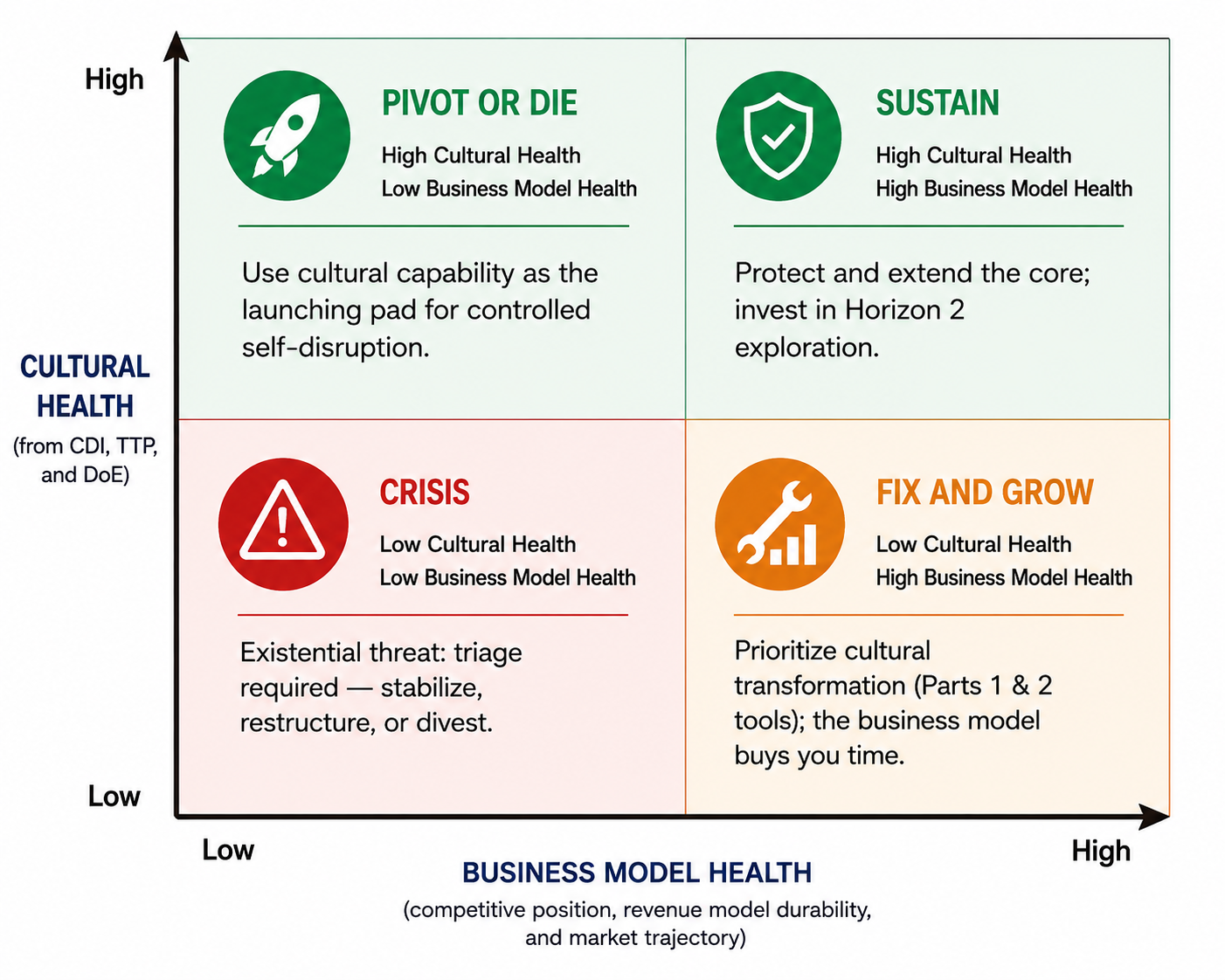 Figure 9: Business Viability Matrix, positioning your organization across cultural and strategic health.
The four quadrants describe four strategic situations:
Table 3: Business Viability Matrix, Strategic Postures
| Quadrant | Cultural Health | Business Model Health | Strategic Posture |
|---|---|---|---|
| Sustain | High | High | Protect and extend the core; invest in Horizon 2 exploration |
| Fix and Grow | Low | High | Prioritize cultural transformation (Parts 1 & 2 tools); the business model buys you time |
| Pivot or Die | High | Low | Use cultural capability as the launching pad for controlled self-disruption |
| Crisis | Low | Low | Existential threat: triage required (stabilize, restructure, or divest) |
Business Model Health has three dimensions.
-
Revenue model durability. How defensible is your pricing mechanism? How concentrated is your customer base? How commoditized is your core offering becoming? A business where the top three customers represent more than 40% of revenue, or where margins have declined for three consecutive years, has structural fragility whatever its cultural health.
-
Competitive advantage sustainability. Rita McGrath’s The End of Competitive Advantage (2013) argues that durable competitive advantages are increasingly rare in fast-moving industries. The relevant question is not “do we have a competitive advantage?” but “how long will it last, and what will replace it?” Advantages rooted in proprietary data, network effects, or embedded switching costs tend to be more durable than those based on product features or process efficiency alone.
-
Market trajectory. Is the served market growing, stable, or contracting? Are there disruptive entrants operating in adjacent markets that are improving rapidly? Larry Greiner’s research on organizational evolution (1972) shows that each phase of growth brings its own crisis. Where your market sits in its own lifecycle matters as much as where your organization sits on its S-curve.
Connecting Cultural and Business Health
The culture and business health model from Part 1 (Figure 4) showed that the two depend on each other over the organizational lifetime. The viability matrix adds the strategic dimension. Even if you restore cultural health with the tools of Part 2, a deteriorating business model will eventually overwhelm the recovery. The reverse also holds: a sound business model will erode if cultural drag goes unaddressed.
The ideal position is the Sustain quadrant, with high cultural health and a durable business model. From there you can afford the strategic risk of controlled self-disruption, investing in new models while the core business funds the exploration. Organizations that wait until they are in the Crisis quadrant have lost that option.
Controlled Self-Disruption
Controlled self-disruption is the deliberate, structured practice of questioning and, where necessary, cannibalizing your own business before external forces do it for you. It is not restructuring, cost reduction, or crisis response. It is a strategic capability you develop in periods of strength, not weakness.
Gary Hamel and C. K. Prahalad’s Competing for the Future (1994) argued that companies that lead their industries over the long term shape the future instead of reacting to it. Intel’s decision to exit the memory chip business, the product line it was founded on, and focus entirely on microprocessors is a classic example. IBM’s repeated reinventions, from hardware to services to software to consulting, are another. In both cases the self-disruption was painful, politically contested, and strategically uncertain, and the alternative was irrelevance.
The Three Tests of Controlled Self-Disruption
Before pursuing self-disruption, apply three tests.
-
The Market Test. Is there an emerging segment (currently underserved, non-consuming, or served by lower-quality alternatives) that a simplified or lower-cost version of your offering could capture? If yes, who in your organization is currently ignoring that segment, and why? The answer to “why” usually shows whether this is a deliberate strategic choice or a structural blind spot.
-
The Model Test. Does your current business model structurally prevent you from serving that segment profitably? If so, because your cost structure, sales model, or technical architecture is optimized for the premium end of the market, you have a model problem that internal optimization cannot solve. No amount of cultural transformation fixes a unit economics problem.
-
The Capability Test. Do you have, or can you develop, the capabilities required to serve the emerging opportunity? Are those capabilities currently deployed in your core business in ways that make them difficult to redirect? O’Reilly and Tushman (2016) note that the capabilities required for disruption are often present in the organization but trapped in the core business’s operational logic. They need to be freed, not built from scratch.
If all three tests come back positive (there is a market opportunity, your current model cannot address it, and you have relevant capabilities), the case for controlled self-disruption is strong.
The Ambidextrous Organization
The ambidextrous organization (Tushman & O’Reilly, 1996; O’Reilly & Tushman, 2016) is the organizational design framework for controlled self-disruption that does not destroy the core business.
Organizational design faces a basic tension between exploitation (disciplined refinement and scaling of what already works) and exploration (the uncertain, iterative search for new models and capabilities). James G. March identified this as the central trade-off in organizational learning (1991): exploitation offers predictable, near-term returns, and exploration offers uncertain, long-term ones. Organizations that only exploit eventually become obsolete. Organizations that only explore never develop the operational discipline to scale.
The ambidextrous organization resolves the tension by separating the two activities structurally:
-
The exploit unit (core business) optimizes for efficiency, predictability, and customer satisfaction within the existing model. Its metrics are financial: revenue, margin, NPS, retention. CDI must stay low, so the Part 1 diagnostics apply directly. Leadership is execution-oriented.
-
The explore unit (new ventures) optimizes for learning, speed, and market discovery. Its metrics are about learning: hypotheses tested, customer interviews completed, prototype iterations, validated pivots. It needs a high tolerance for ambiguity. Beating the core business’s CDI is not the goal here, but psychological safety (Edmondson, 2018) is essential: without it, people will not share the failures that generate organizational learning.
Figure 10 shows how the explore and exploit units relate structurally, how their operating systems differ, and how shared executive leadership connects them.
flowchart TB
    EX["Executive integration<br/>Shared strategic intent<br/>One senior leadership team"]
    subgraph L["Exploit unit (core business)"]
        direction TB
        L1["Optimizes efficiency,<br/>predictability, scale"]
        L2["Metrics: revenue, margin,<br/>NPS, retention"]
    end
    subgraph R["Explore unit (new ventures)"]
        direction TB
        R1["Optimizes learning,<br/>speed, market discovery"]
        R2["Metrics: hypotheses tested,<br/>interviews, validated pivots"]
    end
    EX --> L
    EX --> R

    classDef exec fill:#dbeafe,stroke:#2563eb,color:#0f172a
    classDef exploit fill:#fef3c7,stroke:#d97706,color:#0f172a
    classDef explore fill:#d1fae5,stroke:#059669,color:#0f172a
    class EX exec
    class L1,L2 exploit
    class R1,R2 explore
Figure 10: The Ambidextrous Organization, with structurally separated exploit and explore units connected through executive integration.
The key design requirement is executive integration. An ambidextrous organization is not a holding company with two unrelated businesses. It is one organization with two operating systems, held together by a shared strategic intent and a senior leadership team that can manage both. Those leaders must switch between an exploitation mindset (discipline, efficiency, scale) and an exploration mindset (curiosity, tolerance for failure, strategic patience), and they must protect the explore unit from the core business’s instinct to demand short-term financial returns from it.
The Three Horizons Framework
McKinsey’s Three Horizons Framework (Baghai, Coley, & White, 1999) is a portfolio lens for allocating attention, talent, and capital across the exploitation and exploration spectrum.
Table 4: The Three Horizons of Business Development
| Horizon | Time Frame | Focus | Metrics | Cultural Requirements |
|---|---|---|---|---|
| H1: Extend and Defend | 0-2 years | Maximize returns from core business | Revenue, margin, NPS, CDI | Operational discipline, low CDI |
| H2: Build Emerging Businesses | 2-5 years | Scale proven new models | Growth rate, unit economics, customer adoption | Agility, cross-functional collaboration |
| H3: Create Options | 5+ years | Explore transformative opportunities | Hypotheses tested, prototypes validated | Curiosity, tolerance for ambiguity, psychological safety |
The Three Horizons framework is a simultaneous portfolio, not a sequential plan. Successful organizations invest in all three horizons at once and give each a different mix of capital, leadership attention, and talent. The allocation pattern that leads to long-term decline is over-investing in H1 at the expense of H2 and H3. The core business generates the cash, takes most of the executive attention, and crowds out the exploration that would fund the next business cycle.
Connecting the Three Horizons to the S-Curve
Each horizon corresponds to a new S-curve of business development (Figure 1, Part 1). H1 is the mature phase of the current S-curve; H2 is the early growth phase of the next S-curve; H3 is the learning and launch phase of the S-curve after that. An organization that manages all three at once is engineering its own succession before the market forces it to.
The cultural requirements shift significantly across the three horizons. H1 requires the operational discipline a low CDI represents: efficient processes, strong onboarding (low TTP), and stable tenure (high DoE). H3 requires something different: tolerance for ambiguity, a culture of experimentation, and strong psychological safety. The ambidextrous organization must hold both cultural modes at once, which is why it needs structural separation and integrative senior leadership.
When to Pivot: Signals and the Decision Framework
Knowing when controlled self-disruption becomes necessary, and when it turns from strategic boldness into unnecessary risk, is one of the hardest judgments in organizational leadership. No algorithm settles it, but there are clear signals and a structured decision framework.
Signals That Incremental Change Is No Longer Enough
- CDI is rising despite sustained cultural intervention. If you have applied the tools of Parts 1 and 2 for 18-24 months and CDI keeps trending up, the problem may no longer be mainly cultural. It may be structural or strategic.
- Business model health indicators are deteriorating together. Falling price realization, rising customer churn, a shrinking addressable market, and rising customer acquisition costs are lagging indicators that reflect decisions made 12-24 months ago. Seeing them together is a late warning.
- Disruptive entrants are improving faster than your sustaining innovations. A competitor targeting your low-end or non-consuming segment is a leading indicator. By the time they threaten your core customers, the window for a strategic response has narrowed a lot.
- Your best talent is moving to the disruptors. DoE declines concentrated among high-potential people, often engineers, product managers, or strategists, mean the organization’s direction has lost credibility with those most attuned to where the market is heading. Talent movement is one of the earliest and most reliable signals of strategic misalignment.
The Pivot Decision Framework
When these signals accumulate, work through the following assessment:
-
Validate the signal. Is this a genuine strategic threat or a temporary market fluctuation? Use the Three Horizons model to separate short-term noise from long-term pattern. Christensen (1997) warns that disruptive signals are routinely dismissed because the initial market is small.
-
Map the capability delta. What capabilities would the pivot require? How far are those capabilities from the current state? Is the gap bridgeable in the time available, given the rate at which the disruptive entrant is improving?
-
Assess cultural readiness. Does your organization have the psychological safety, cross-functional connectivity, and leadership quality to execute the pivot? The champion network and Pull Engineering infrastructure from Part 2 are your strategic assets here, and organizations that invested in them have a head start.
-
Determine the structural solution. Full pivot of the core business, creation of a separate explore unit, strategic partnership, acquisition, or divestiture? Each has a different cost, speed, and cultural risk profile.
-
Sequence the transition. W. Chan Kim and Renée Mauborgne’s Blue Ocean Strategy (2005) introduces value innovation: creating new market space by reducing the factors the industry competes on while raising factors currently taken for granted, which breaks the cost-value trade-off. A pivot toward blue ocean space differs from a sustaining innovation battle in red ocean space and needs different organizational capabilities and cultural conditions.
Building Antifragility
Nassim Taleb’s antifragility (Antifragile, 2012) is a complementary lens on how organizations should position themselves against disruption. The goal is an organization that gains from disruption instead of merely surviving it (robustness), one where exposure to volatility, uncertainty, and disorder builds capability instead of destroying it.
An antifragile organization treats strategic uncertainty as a way to learn. The Three Horizons portfolio is itself an antifragility design: by keeping active exploration in H2 and H3, the organization makes sure disruptions in H1 create options instead of existential crises. The cultural prerequisites (psychological safety, high tolerance for failure in exploration units, rapid learning loops) are the same ones the ambidextrous organization needs. Both concepts describe the same underlying capability from different angles.
Completing the Loop: The Transformation Cycle
The three parts of this series describe a continuous cycle, not a linear journey: assess, act, reflect, reassess. It is the operating rhythm of an organization that treats transformation as a capability instead of a project.
Figure 11 shows the transformation cycle. It connects the three phases of the series and shows how the output of Part 3 (strategic reflection) feeds back into the diagnostics of Part 1 (cultural assessment), informed by the leadership practices of Part 2 (driving change).
flowchart LR
    P1["Part 1<br/>Cultural assessment<br/>CDI, TTP, DoE"]
    P2["Part 2<br/>Driving change<br/>Leadership practices"]
    P3["Part 3<br/>Strategic reflection<br/>Business model health"]
    P1 -->|"act"| P2
    P2 -->|"reflect"| P3
    P3 -->|"reassess"| P1

    classDef phase1 fill:#dbeafe,stroke:#2563eb,color:#0f172a
    classDef phase2 fill:#fef3c7,stroke:#d97706,color:#0f172a
    classDef phase3 fill:#d1fae5,stroke:#059669,color:#0f172a
    class P1 phase1
    class P2 phase2
    class P3 phase3
Figure 11: The Transformation Cycle, a continuous loop of cultural assessment, leadership-driven change, and strategic reflection.
The cycle does not end. An organization that reaches the Sustain quadrant of the Business Viability Matrix does not graduate from transformation. It reaches the point where it can pursue the next S-curve from a position of strength, and the tools of this series become its operating system.
Institutionalizing Strategic Reflection
The last challenge is making the cycle operational: a continuous, embedded practice instead of a one-off strategic planning exercise. Mechanisms that help:
-
Annual business viability reviews. Structured assessments of the Business Viability Matrix that combine updated CDI, TTP, and DoE data with market and competitive intelligence. This applies the diagnostic rigor of Part 1 to strategic questions, not just cultural ones.
-
Quarterly champion network meetings. The cross-functional network of Early Adopters from Part 2 becomes the sensing mechanism for emerging signals that feed Part 3’s strategic reflection. These people are closest to market edges, talent trends, and technology shifts.
-
Horizon portfolio governance. A standing committee or leadership forum that explicitly allocates resources across H1, H2, and H3, so that H1 operational pressure does not crowd out H2 and H3 investment. Without explicit governance, H1 wins by default every time.
-
Psychological safety as a cultural baseline. Amy Edmondson’s research (2018) shows that organizations with high psychological safety learn faster, adapt faster, and perform better in uncertain environments. It is an ongoing leadership practice that needs active reinforcement, especially during the cultural dips that deep transformation produces (see Figure 4, Part 1).
Conclusion: Transformation as a Strategic Capability
This series treats organizational transformation as a permanent strategic capability instead of an episodic crisis response:
- Part 1 gave you the diagnostic instruments (the S-curve, TTP, DoE, CDI, and the business and culture health model) to understand where you stand.
- Part 2 gave you the leadership engine (Pull Engineering, the Diffusion of Innovations model, Conway’s Law, prototyping, and the movement-building architecture) to move the organization toward the desired state.
- Part 3 gave you the strategic lens (the Innovator’s Dilemma, controlled self-disruption, the ambidextrous organization, the Three Horizons Framework, and the pivot decision framework) to check that the transformation points in the right direction.
Together they form an evidence-based approach to one of the hardest challenges in leadership: changing an organization while keeping it running, building the next business while defending the current one, and keeping the clarity of purpose that makes it worth doing.
The most dangerous moment in any transformation is when it starts to feel finished. It never is. With the right diagnostics, leadership practices, and strategic framework, that continuing uncertainty stops being a threat to manage and becomes what makes an organization capable.
Series Bibliography
- Adizes, I. (1999). Managing Corporate Lifecycles. Prentice Hall.
- Allen, D. G. (2008). Retaining Talent: A Guide to Analyzing and Managing Employee Turnover. SHRM Foundation Effective Practice Guidelines Series.
- Baghai, M., Coley, S., & White, D. (1999). The Alchemy of Growth: Practical Insights for Building the Enduring Enterprise. Perseus Books.
- Bauer, T. N. (2010). Onboarding New Employees: Maximizing Success. SHRM Foundation Effective Practice Guidelines Series.
- Beer, M., Eisenstat, R. A., & Spector, B. (1990). Why change programs don’t produce change. Harvard Business Review, 68(6), 158-166.
- Brown, T. (2009). Change by Design: How Design Thinking Transforms Organizations and Inspires Innovation. HarperBusiness.
- Cameron, K. S., & Quinn, R. E. (2011). Diagnosing and Changing Organizational Culture: Based on the Competing Values Framework (3rd ed.). Jossey-Bass.
- Christensen, C. M. (1997). The Innovator’s Dilemma: When New Technologies Cause Great Firms to Fail. Harvard Business Review Press.
- Conway, M. E. (1968). How do committees invent? Datamation, 14(4), 28-31.
- Edmondson, A. C. (2018). The Fearless Organization: Creating Psychological Safety in the Workplace for Learning, Innovation, and Growth. Wiley.
- Foster, R. N. (1986). Innovation: The Attacker’s Advantage. Summit Books.
- Gladwell, M. (2000). The Tipping Point: How Little Things Can Make a Big Difference. Little, Brown.
- Greiner, L. E. (1972). Evolution and revolution as organizations grow. Harvard Business Review, 50(4), 37-46.
- Hamel, G., & Prahalad, C. K. (1994). Competing for the Future. Harvard Business School Press.
- Kim, W. C., & Mauborgne, R. (2005). Blue Ocean Strategy: How to Create Uncontested Market Space and Make Competition Irrelevant. Harvard Business Review Press.
- Kotter, J. P. (1996). Leading Change. Harvard Business Review Press.
- Kotter, J. P., & Heskett, J. L. (1992). Corporate Culture and Performance. Free Press.
- Lewin, K. (1947). Frontiers in group dynamics. Human Relations, 1(1), 5-41.
- March, J. G. (1991). Exploration and exploitation in organizational learning. Organization Science, 2(1), 71-87.
- McGrath, R. G. (2013). The End of Competitive Advantage: How to Keep Your Strategy Moving as Fast as Your Business. Harvard Business Review Press.
- Moore, G. A. (1991). Crossing the Chasm: Marketing and Selling High-Tech Products to Mainstream Customers. HarperBusiness.
- O’Reilly, C. A., & Tushman, M. L. (2016). Lead and Disrupt: How to Solve the Innovator’s Dilemma. Stanford University Press.
- Pink, D. H. (2009). Drive: The Surprising Truth About What Motivates Us. Riverhead Books.
- Ries, E. (2011). The Lean Startup: How Today’s Entrepreneurs Use Continuous Innovation to Create Radically Successful Businesses. Crown Business.
- Rogers, E. M. (2003). Diffusion of Innovations (5th ed.). Free Press. (Original work published 1962)
- Rollag, K., Parise, S., & Cross, R. (2005). Getting new hires up to speed quickly. MIT Sloan Management Review, 46(2), 35-41.
- Schein, E. H. (2010). Organizational Culture and Leadership (4th ed.). Jossey-Bass.
- Senge, P. M. (1990). The Fifth Discipline: The Art and Practice of the Learning Organization. Doubleday.
- Taleb, N. N. (2012). Antifragile: Things That Gain from Disorder. Random House.
- Thaler, R. H., & Sunstein, C. R. (2008). Nudge: Improving Decisions About Health, Wealth, and Happiness. Yale University Press.
- Tushman, M. L., & O’Reilly, C. A. (1996). Ambidextrous organizations: Managing evolutionary and revolutionary change. California Management Review, 38(4), 8-30.
- Westerman, G., Bonnet, D., & McAfee, A. (2014). Leading Digital: Turning Technology into Business Transformation. Harvard Business Review Press.
- Worley, C. G., & Mohrman, S. A. (2014). Is change management obsolete? Organizational Dynamics, 43(3), 214-224.